🔓 512 k lines of Claude exposed—what hidden backdoors and undocumented features did the leak reveal?
The trigger: a packaging slip that opened the floodgates
On March 31 Anthropic shipped version 2.1.88 of the @anthropic-ai/claude-code npm package with a 59.8 MB source‑map file accidentally bundled. The map exposed 512 000 lines of unobfuscated TypeScript across 1 906 files. Within minutes Chaofan Shou announced the find on X; within hours mirror repos proliferated on GitHub.
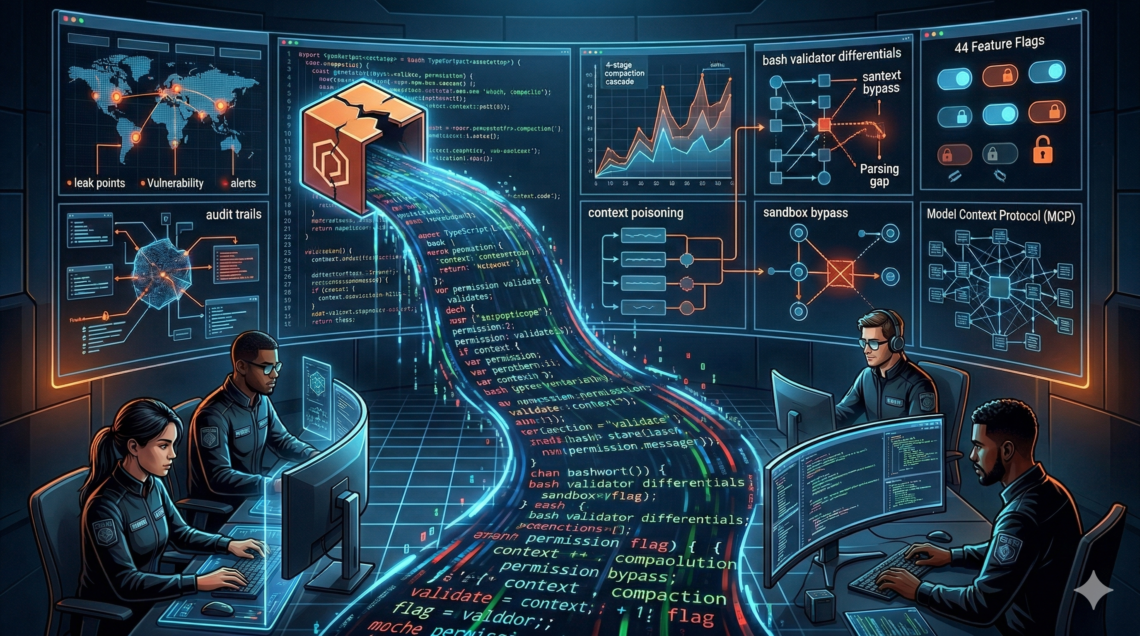
No model weights or customer data left the vault, but the breach stripped away the only veil Anthropic had over its agentic harness. The code now shows every permission check, every bash validator, and 44 unreleased feature flags that were supposed to stay secret.
The audit: security teams tear the code apart
Permission model in the open
The harness implements a per‑tool permission schema. Each of the 40+ built‑in tools carries a JSON contract and a granular allow/deny list. The source reveals 23 sequential bash validators (≈2 500 lines) that filter commands for Zsh builtins, Unicode zero‑width spaces, IFS null‑byte injection, and more.
A subtle bug surfaces: three independent parsers treat carriage returns differently. One parser splits on \r, another does not, creating a sandbox‑bypass gap that early‑allow checks can exploit.
The query engine and context compaction
A 46 k‑line query engine compresses context through a four‑stage cascade. MCP tool results are never micro‑compacted; read‑tool results skip budgeting entirely. The pipeline’s exact criteria are now public, making context poisoning trivial: a malicious instruction placed in a CLAUDE.md file survives compaction, is laundered into a “user directive,” and the cooperative model dutifully executes it.
Feature flags that never shipped
Among the flags are KAIROS, ULTRAPLAN, and coordinator mode. They hint at a “Proactive” mode that can act without a prompt, remote planning windows, and multi‑agent orchestration. Competitors now have a blueprint for autonomous coding agents that Anthropic has not yet released.
Supply‑chain coincidence
The leak window (00:21‑03:29 UTC) overlapped with a malicious axios package that dropped a remote‑access trojan onto the same npm registry. Any install of Claude Code during that window fetched both the source map and the unrelated malware.
The fallout: a scramble and a warning bell
Anthropic’s response was a DMCA takedown that unintentionally hit 8 000 forks before being retracted. The Wall Street Journal notes the company’s post‑mortem is the first of more than a dozen incidents in March, including a CMS misconfiguration that exposed internal assets for an unreleased model called Claude Mythos.
Gartner’s same‑day advisory warned that the gap between Anthropic’s product capability and its operational discipline “should force leaders to rethink how they evaluate AI development tool vendors.”
CrowdStrike CTO Elia Zaitsev summed it up at RSAC 2026:
“Don’t give an agent access to everything just because you’re lazy. Give it only what it needs to get the job done.”
His point is not rhetorical; the leak shows exactly why. The permission chain can be short‑circuited, the context pipeline can be poisoned, and the code that should have been a defensive layer is now a playbook for attackers.
What enterprises must audit right now
| Exposed layer | Attack path enabled | Immediate audit |
|---|---|---|
| 4‑stage compaction pipeline | Context poisoning via CLAUDE.md | Scan every cloned repo for executable‑looking config files; treat them as code, not metadata. |
| Bash validators (2 500 lines) | Sandbox bypass through parser differentials | Harden bash permission rules; disallow broad patterns like Bash(git:*). |
| MCP server contract | Malicious server masquerading as legitimate tool | Pin MCP versions, vet interfaces, monitor for contract changes. |
| 44 feature flags | Unreleased autonomous modes become attack surface | Inventory flag usage; disable any flag not explicitly needed in production. |
| Undercover module (90 lines) | AI‑generated commits lose attribution | Enforce commit provenance checks; require AI‑disclosure policies. |
Five concrete actions for security leaders this week
- Audit every
CLAUDE.mdand.claude/config.jsonin all cloned repositories. Treat them as executable code and run static analysis. - Treat MCP servers as untrusted dependencies. Pin exact versions, vet the JSON schema before enabling, and set up runtime monitoring for contract drift.
- Restrict bash permissions to the minimum required set and enable pre‑commit secret scanning. The leak’s 3.2 % secret‑leak rate translates to three exposed credentials per 100 commits.
- Demand SLAs, uptime history, and incident‑response documentation from any AI coding‑agent vendor. Build provider‑independent integration layers that allow a 30‑day vendor switch.
- Implement commit provenance verification. The
undercover.tsmodule can strip AI attribution; enforce a policy that every AI‑generated change is tagged and auditable.
The broader implication: trust vs. openness in AI development
Anthropic’s codebase is ≈90 % AI‑generated. Under current U.S. copyright law, AI‑authored code enjoys diminished protection, meaning the leak is effectively public domain. Any company that ships AI‑generated production code now faces the same unresolved IP exposure.
The leak also hands competitors a complete road map to clone Claude Code’s capabilities without reverse engineering. Startups can now replicate the multi‑tool orchestration, proactive planning, and granular permission system in days instead of months.
For enterprises, the lesson is stark: openness without disciplined operational hygiene is a liability. The same mechanisms that let Claude Code act as a powerful assistant also provide a detailed attack surface when the source is exposed.
Bottom line: the Claude Code leak isn’t a headline‑grabbing “source‑code breach” story; it’s a forensic case study in how a single packaging error can turn a cutting‑edge AI agent into an open‑source weapon. The engineering reality is clear—if you hand an AI agent the keys to your kingdom, lock those keys behind a rigorously audited, minimally‑privileged gate, or watch the whole castle burn.
The future of trustworthy AI hinges on the same principle that kept the early internet alive: code is power, and power must be guarded, not glorified.