The voice agent stack, piece by piece: 30 tools, priced
A layered map of everything you need to ship a voice agent, from speech recognition to phone lines, with every tool's pricing unit as published and three starter stacks costed per minute.
The short answer
A voice agent stack has five layers: telephony, orchestration, a brain that is either a chained STT, LLM and TTS pipeline or one speech-to-speech model, optional open-weight models, and testing. At list prices on 27 Nov 2026, a lean managed stack costs about $0.03 per call-minute.
Key takeaways
- Decide the brain first: a chained STT, LLM and TTS pipeline gives you a transcript to log and check, while speech-to-speech models like GPT-Live or Gemini Live feel more natural and are harder to audit.
- Pricing units differ by layer: STT is per minute or per hour, TTS per character, speech-to-speech per million audio tokens or per minute, so convert everything to cost per call-minute before comparing.
- Token-billed realtime sessions get more expensive as a call goes on, because the whole conversation is re-sent each turn.
- A lean managed stack (Telnyx, LiveKit, Deepgram Nova-3, Gemini 3.1 Flash-Lite, Azure Neural TTS) works out to about $0.032 per minute at list prices; bundled platforms run roughly $0.06 to $0.31.
- For Arabic, vendor docs confirm support at Azure, Speechmatics, Deepgram Nova-3, ElevenLabs, Gemini Live and Whisper; the self-hosted path still lacks a confirmed open Arabic TTS.
- Deadlines to note: OpenAI's legacy TTS models shut down on 6 Jan 2027, its legacy transcription models on 26 Feb 2027, and Gemini TTS prices double on 1 Jan 2027.
A voice agent is five layers: telephony to carry the call, orchestration to manage turns and interruptions, a “brain” that’s either a chained speech-to-text → LLM → text-to-speech pipeline or a single speech-to-speech model, optional open-weight models if you self-host, and testing across all of it. Below are 30 tools across those layers, each with the pricing unit exactly as the vendor publishes it, checked on 27 November 2026, plus three starter stacks with the cost per minute worked out from list prices.
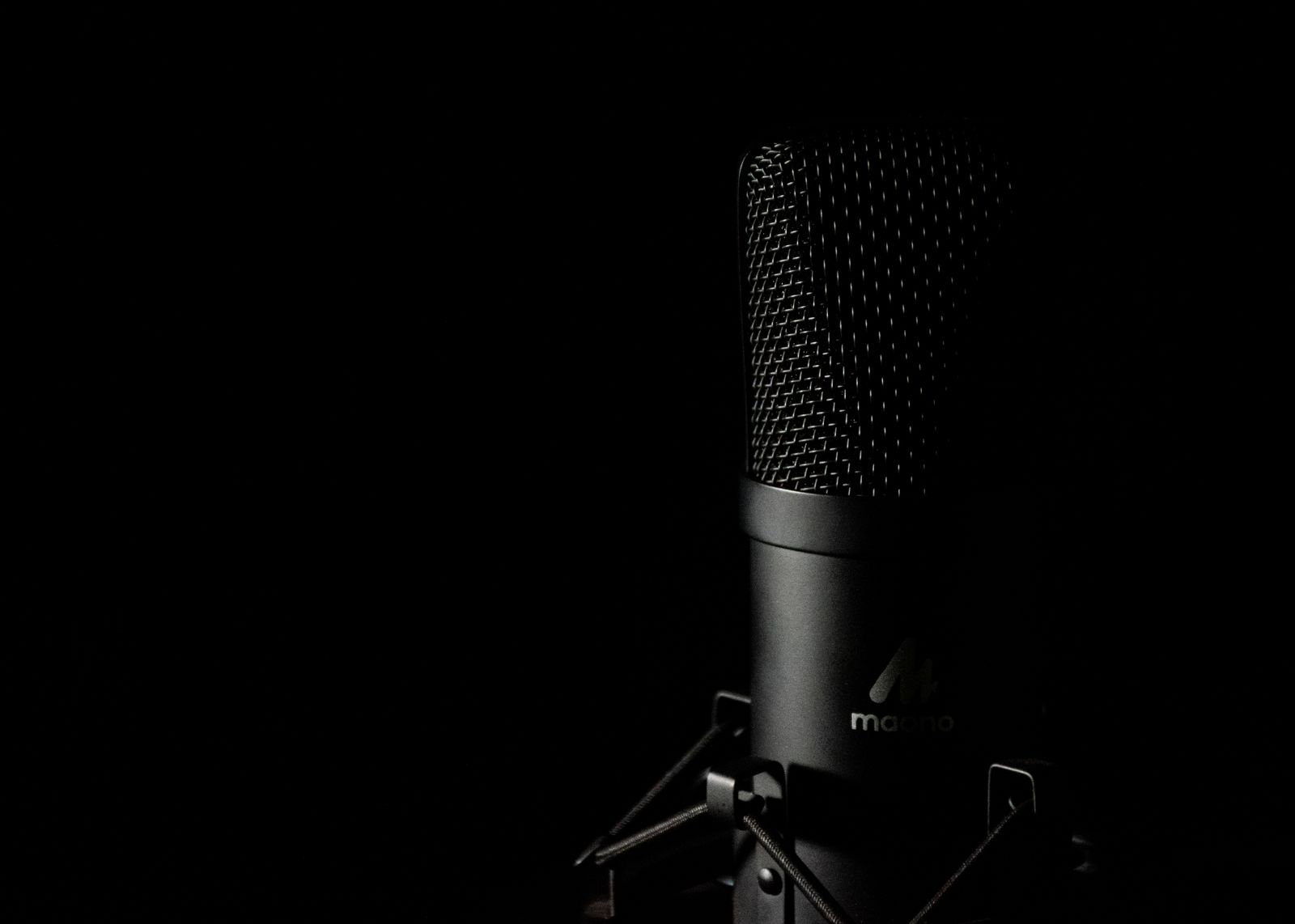
Every voice agent starts here: a microphone and a lot of plumbing. Photo: Nishant Ghosh / Pexels
Voice-agent tooling grew the same way the rest of the agent world did this year: very fast and with no map. Every vendor’s landing page says “ultra-low latency” and “human-like”, and every pricing page uses a different unit. One charges per minute, the next per character, the next per million audio tokens, and one sells “credits” that turn into characters at a rate you find in the FAQ. You can’t compare stacks until everything is in the same unit, so that’s most of what this post does.
How did tools get on this list?
The same three filters as The Agent Builder’s Stack:
- It’s shipping right now. The product page and pricing page loaded on 27 Nov 2026, and open-source repos are actively maintained.
- It does one clear job in the stack. Each tool sits in one layer. Platforms that cover several layers are listed under orchestration, with what they bundle spelled out.
- The price is public, or it plainly says “talk to sales”. I quote the unit the vendor uses: per minute, per hour, per character, per token, or credits. Where a vendor only quotes on request, the table says so. I didn’t estimate any vendor prices.
The rule that keeps this from being pay-to-play: nobody paid to be here, there are no affiliate links, and no vendor saw this before it went live. Every link goes to the vendor’s own site, docs or repo.
How to read the price columns. “Unit” is the billing unit as published. “Price” is the pay-as-you-go list rate in USD on 27 Nov 2026, before free tiers, credits, volume discounts or promos running out. Several prices below are promos or change on a set date, and I’ve flagged those.
The stack as a layered diagram
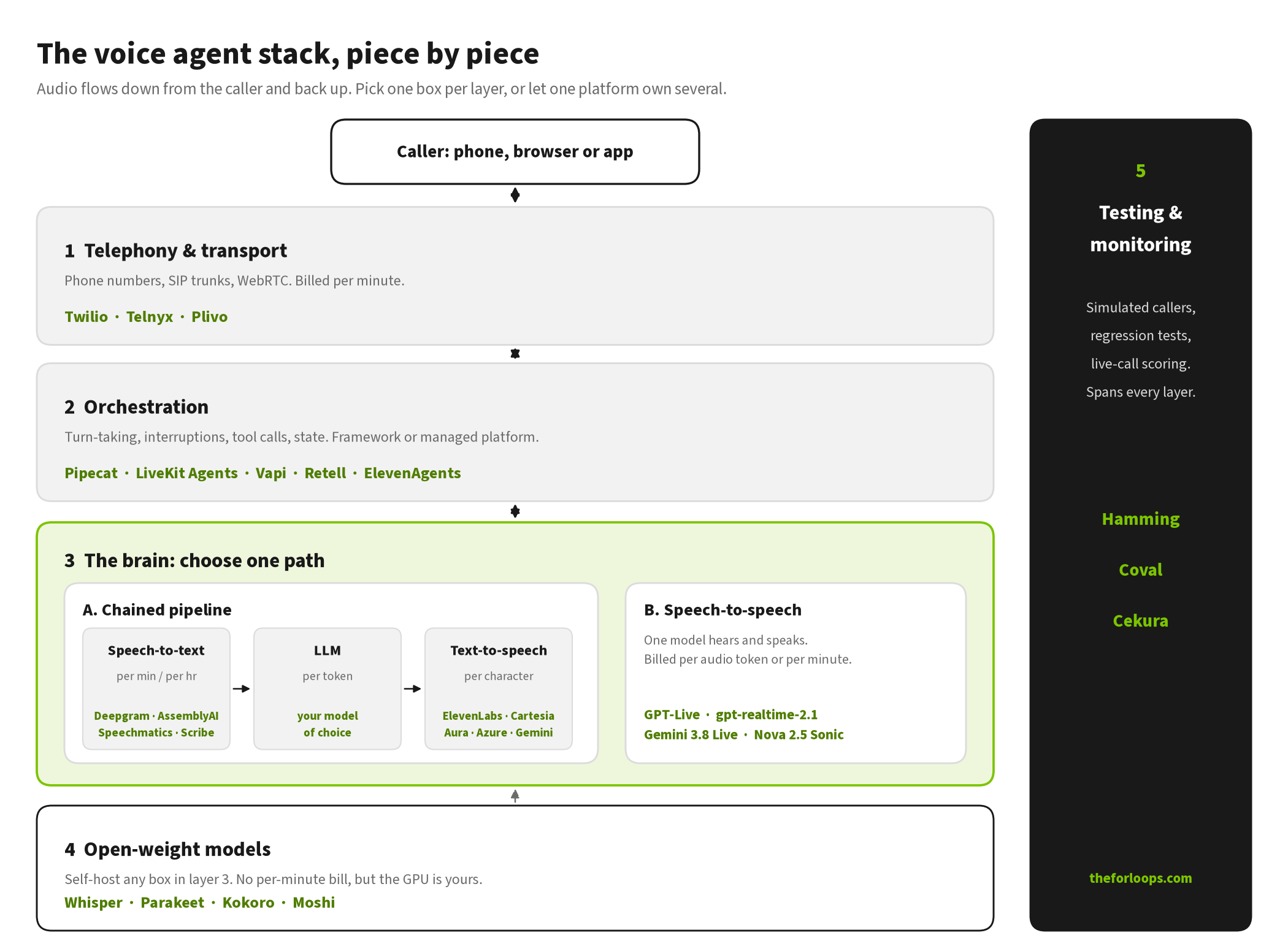
The voice agent stack in five layers. Diagram: theforloops
The one design decision that matters most sits in layer 3. OpenAI’s own voice-agent guide puts it this way: you choose between a full-duplex live model with a separate backend, a single speech-to-speech model, or a chained pipeline “when you want to inspect or transform text between speech recognition, your agent, and speech generation”. The chained path costs you some latency and gives you a transcript you can log, check against policy and route. The speech-to-speech path feels more natural and is harder to audit. If you work anywhere regulated, that trade-off usually decides it for you.
Speech-to-speech models: which realtime voice model should you use?
One model listens and talks back, so there’s no separate STT or TTS bill. The catch is the pricing unit. Most are billed in audio tokens, and token-billed sessions get more expensive as the call goes on. OpenAI’s Realtime cost guide says it directly: “The entire conversation is sent to the model for each Response”, so “turns later in the session will be more expensive”. Caching softens this. It doesn’t make it go away.
| Tool | Best for | Skip if | Unit (as published) | Price (checked 27 Nov 2026) | Link |
|---|---|---|---|---|---|
| OpenAI GPT-Live-1.1 | Full-duplex conversations that hand reasoning and tools to a separate backend you already run | You want one bill. Backend model and tool usage are charged on top | Per minute of session, billed per second | $0.05/min active, $0.02/min standby. Backend billed separately | openai.com |
| OpenAI gpt-realtime-2.1 / 2.1 mini | One model that hears, reasons, calls tools and speaks, over WebRTC, WebSocket or SIP | Calls are long and context-heavy, because every turn re-sends the conversation | Per 1M tokens (audio, text, image priced separately) | 2.1: audio $32 in / $64 out. Mini: audio $10 in / $20 out | openai.com |
| Google Gemini 3.8 Live | Low-cost speech-to-speech with 99 listed languages, Arabic included | You need fixed per-minute billing for budgeting | Per 1M tokens, with Google’s per-minute equivalents | Audio in $3.00 (≈$0.005/min), audio out $12.00 (≈$0.018/min). Text $0.75 in / $4.50 out | ai.google.dev |
| Amazon Nova 2.5 Sonic | AWS teams that want speech-to-speech inside Bedrock, IAM and their own region | You’re not on AWS. Also, I couldn’t find a published audio-tokens-per-second rate, so per-minute cost can’t be computed from the price list | Per 1K tokens (speech and text priced separately) | Speech in $0.003, speech out $0.012 per 1K tokens (us-east-1, AWS Price List API) | aws.amazon.com |
The per-minute maths for OpenAI is published, which is rare. User audio is “1 token per 100 ms” and assistant audio is “1 token per 50ms”. So 30 seconds of caller audio plus 30 seconds of agent audio on gpt-realtime-2.1 mini costs about $0.015 on the first pass (300 tokens × $10/1M + 600 tokens × $20/1M). Context re-sent on later turns comes on top of that. On the full gpt-realtime-2.1, the same minute is about $0.048 before context.
GPT-Live-1.1 is the newest entry here. OpenAI moved it into the API on 19 November:
Speech-to-text: which STT API is best for a voice agent?
For an agent you want streaming transcription with good turn detection, because knowing when the caller has finished matters as much as accuracy. All of these bill on the audio you stream, so a 10-minute call is 10 minutes of STT whether anyone’s talking or not.
| Tool | Best for | Skip if | Unit (as published) | Price (checked 27 Nov 2026) | Link |
|---|---|---|---|---|---|
| Deepgram Flux / Nova-3 | Agents that need turn detection built into the STT model (Flux), or broad language coverage (Nova-3, Arabic included) | Your language isn’t on Flux’s list. Flux comes in English and Multilingual variants, so check before you build on it | Per minute, billed per second | Flux English $0.0065/min (promo, was $0.0077). Nova-3 Monolingual $0.0048/min (promo, was $0.0077) | deepgram.com |
| AssemblyAI STT-3.7 Realtime-Agent | A streaming model built specifically for voice agents, with free auto-scaling concurrency | You’re optimising for the lowest per-minute price | Per hour | $0.45/hr for the agent model ($0.0075/min). $0.30/hr for meetings and captions | assemblyai.com |
| Speechmatics | Arabic, including “Arabic spoken in the Gulf, Egypt, and the Levant”, plus an Arabic–English bilingual mode for code-switching, and a turn-aware voice-agent model (Linden 1) | You’re optimising purely for price. Its list rates sit above Deepgram’s | Per hour, billed to the second (via credits) | Real-time list rates: Linden 1 $0.30/hr (promo, was $0.40), Melia 1 $0.40/hr, Standard $0.45/hr, Enhanced $0.80/hr. Discounts up to 33% if you opt in to model training, and up to 25% on annual plans | speechmatics.com |
| ElevenLabs Scribe v3 Live | Teams already using ElevenLabs voices who want one vendor and one bill | You only need STT. Specialists are cheaper per hour | Per hour | Scribe v3 Live $0.22/hr. Scribe v3 (files) $0.20/hr | elevenlabs.io |
| Cartesia Ink-2 | Latency-first agents. Cartesia says “Time to final transcript is 0.1s” | You want simple dollar pricing. Ink bills in credits | Credits per second of audio | 3 credits/sec. Cartesia quotes $0.39/hr on its Scale plan | cartesia.ai |
| OpenAI GPT-Live-Transcribe | Streaming transcription with keyword and language hints, from the same vendor as your realtime model | You want the lowest price. For recorded files, gpt-transcribe is $0.0045/min | Per minute | $0.017/min | openai.com |
A note on OpenAI if you built on it last year: whisper-1, gpt-4o-transcribe and gpt-4o-mini-transcribe are deprecated and shut down on 26 February 2027. Plan the migration now, not in February.
Text-to-speech: which TTS sounds good enough without wrecking latency?
TTS is usually the biggest line on a chained stack’s bill, and this is the layer with the messiest units. To compare them I use LiveKit’s published calculator assumption of 600 characters of agent speech per call-minute. Cartesia’s own FAQ puts a minute of continuous audio at 750–800 characters, so 600 per call-minute (where the agent isn’t talking the whole time) is reasonable.
| Tool | Best for | Skip if | Unit (as published) | Price (checked 27 Nov 2026) | Link |
|---|---|---|---|---|---|
| ElevenLabs (Eleven v4, v4 Turbo, Flash v2.5) | Voice quality and range, with Arabic (Saudi Arabia, UAE) listed in its multilingual docs | Cost per minute is your main metric | Per 1K characters | Eleven v4 $0.08. v4 Turbo (~100ms) and Flash/Turbo (~75ms) $0.04 | elevenlabs.io |
| Cartesia Sonic-3.6 | Speed. Cartesia advertises “first audio in under 90ms” in 44 languages | You hate maths. Credits are priced by plan, and overages cost $65–$38 per 1M credits depending on tier | Credits (1 credit per character) | Startup: $49/mo for 1.25M credits. Scale: $299/mo for 8M | cartesia.ai |
| Deepgram Aura-2 / Flux TTS | One vendor for STT and TTS, with TTS that Deepgram says “streams in as low as 80ms” (Flux TTS) | You need Arabic voices, which I couldn’t confirm in Aura’s docs | Per 1K characters | Aura-2 $0.030. Flux TTS $0.045. Aura-1 $0.015 | deepgram.com |
| Azure AI Speech (Neural TTS) | Arabic at scale. Azure’s language-support page lists 18 Arabic locales, from ar-SA and ar-AE to ar-EG | You want the most expressive voice in a demo | Per 1M characters | Neural $15 per 1M characters, HD $22 (East US, Azure Retail Prices API). 0.5M characters free per month | azure.microsoft.com |
| Google Gemini 3.8 Flash TTS / Flash-Lite TTS | Cheap, controllable TTS from the same API key as your Gemini LLM | You’re budgeting past New Year. Both prices double on 1 Jan 2027 | Per 1M audio tokens (25 tokens per second of audio) | Flash-Lite: $6.00 (≈$0.009 per minute of audio), $12.00 from 1 Jan. Flash: $9.00, $18.00 from 1 Jan | ai.google.dev |
Two more things worth knowing. OpenAI’s tts-1, tts-1-hd and gpt-4o-mini-tts shut down on 6 January 2027. OpenAI’s migration path is gpt-realtime-2.1-mini via the Realtime API, which is a different API workflow, not a model swap. AssemblyAI also launched a TTS model at $15 per 1M characters, but it currently covers only English, Spanish, French, German, Italian and Portuguese.
On Arabic. I’ve built a platform with 30+ Arabic and English voices, so “does it do Arabic, and which Arabic?” is the first filter I apply. The vendors that answer that question clearly in their docs are Azure (18 Arabic locales), Speechmatics (Gulf, Egyptian and Levantine Arabic plus an Arabic–English bilingual mode), Deepgram Nova-3 (Arabic with ar-SA, ar-AE, ar-QA, ar-KW and more), ElevenLabs (Arabic for Saudi Arabia and the UAE), Gemini Live (Arabic among its 99 languages) and Whisper. Every other tool here may well handle Arabic. I just couldn’t confirm it from their docs, so I haven’t claimed it. If your callers are in the Gulf, test with real Gulf audio before you trust any features page, this one included.
Open-weight voice models: what can you actually self-host?
These replace boxes in layer 3 at no licence cost. You pay for the GPU and the ops instead, which no vendor publishes a per-minute rate for. Check the licence before you ship, because they aren’t all the same.
| Tool | Best for | Skip if | Unit (as published) | Price (checked 27 Nov 2026) | Link |
|---|---|---|---|---|---|
| OpenAI Whisper | Self-hosted, multilingual STT (Arabic included) under an MIT licence | You need streaming with turn detection out of the box. Whisper doesn’t include it | No usage pricing (open source) | Free, MIT licence. Your compute | github.com |
| NVIDIA Parakeet TDT 0.6B v3 | Fast, high-throughput STT in 25 European languages | You need Arabic or any language outside those 25 | No usage pricing (open weights) | Free, CC-BY-4.0. Your compute | huggingface.co |
| Kokoro-82M | Tiny (82M parameter) open TTS you can run almost anywhere, Apache-licensed | You need Arabic. It isn’t in Kokoro’s voice list, and its voice list warns that non-English support “may be absent or thin” | No usage pricing (open weights) | Free, Apache 2.0. Your compute | huggingface.co |
| Kyutai Moshi | Self-hosted full-duplex speech-to-speech, with a “practical overall latency as low as 200ms on an L4 GPU” | You need tool calling and business logic more than a natural back-and-forth | No usage pricing (open weights) | Free. Weights CC-BY 4.0, code MIT/Apache. Your compute | github.com |
Telephony: what does it cost to put an agent on a phone number?
The least glamorous layer, and the one callers notice first when it goes wrong. Every vendor here bills per minute, and inbound and outbound are priced differently.

Telephony is the least glamorous layer and the one your callers notice first. Photo: Yan Krukau / Pexels
| Tool | Best for | Skip if | Unit (as published) | Price (checked 27 Nov 2026) | Link |
|---|---|---|---|---|---|
| Twilio Programmable Voice | The deepest ecosystem, docs and number inventory (“over 100 locales”) | You’re cost-sensitive at volume. It’s the priciest per minute of the three | Per minute, plus per month per number | US local: $0.0140/min outbound, $0.0085/min inbound, number $1.15/mo. SIP/BYOC $0.0040/min. Media Streams $0.0044/min | twilio.com |
| Telnyx | Low carrier rates on its own network, plus a bundled voice-AI engine if you want one | You want the biggest third-party tutorial ecosystem | Per minute | US local: from $0.005/min outbound, from $0.0032/min inbound (Elastic SIP) | telnyx.com |
| Plivo | A cheaper Twilio-style API with SIP and browser calling | You need features beyond core voice, and Plivo’s catalogue is smaller | Per minute | US local: $0.0115/min outbound, $0.0055/min inbound. SIP/browser $0.0033/min | plivo.com |
Orchestration: framework or managed platform?
This layer handles turn-taking, interruptions, tool calls and state. It’s also where most of the hard engineering lives. You can run an open-source framework yourself or rent a platform that bundles several layers into one per-minute rate. Bundles are convenient, but always check what the headline per-minute rate leaves out. It’s usually the LLM and the phone line.
| Tool | Best for | Skip if | Unit (as published) | Price (checked 27 Nov 2026) | Link |
|---|---|---|---|---|---|
| Pipecat (by Daily) | An open-source Python framework where you choose every STT, LLM and TTS provider | You want a dashboard instead of code | Framework: none. Pipecat Cloud: per minute | Free, BSD 2-Clause. Pipecat Cloud agent-1x: $0.01/min active | github.com |
| LiveKit Agents | An open-source framework (Apache 2.0) on WebRTC infrastructure, with a managed cloud and built-in inference | You only need phone calls and don’t want WebRTC at all | Per minute (LiveKit Cloud) | Build $0/mo with 1,000 agent minutes. Then $0.01/min agent session, $0.004/min third-party SIP, plus models | livekit.com |
| Vapi | Getting a phone agent live fast, with models passed through at cost | You want predictable invoices. Several vendors bill at once | Per minute | $0.05/min hosting plus models at cost plus transport. Optional Core package $29/mo | vapi.ai |
| Retell AI | A managed platform where the per-minute price covers voice infrastructure, with LLM and TTS shown separately | You need full control of the pipeline | Per minute | $0.07–$0.31/min depending on the LLM, voice and telephony you pick. Voice infrastructure $0.055/min | retellai.com |
| ElevenLabs Agents | Teams that want ElevenLabs voices with hosting and turn-taking bundled in | You want the LLM and telephony on the same bill. Both are extra | Per minute | Plan quotas, then $0.08/min. LLM billed separately, telephony at cost | elevenlabs.io |
Also worth a look: Telnyx Voice AI at $0.05/min for orchestration, STT and TTS combined. Telnyx says a production agent “lands near $0.06 per minute” once you add LLM and carrier. Deepgram’s Voice Agent API is $0.075/min standard, or $0.050/min if you bring your own LLM and TTS. Cartesia Managed Agents is $0.03/min (marked “previously $0.06”) plus $0.014/min for a Cartesia phone number.
Testing and monitoring: how do you know the agent works?
A voice agent demos well in a quiet office and then a real caller rings from a car on the Riyadh ring road. Testing tools run simulated callers with accents, noise and interruptions, then score live calls. Even the people building these tools say it’s hard to get right. Here’s Kwindla Hultman Kramer of Daily, the company behind Pipecat:
| Tool | Best for | Skip if | Unit (as published) | Price (checked 27 Nov 2026) | Link |
|---|---|---|---|---|---|
| Hamming | Enterprise teams that want testing, red-teaming and production monitoring in one contract | You want to self-serve with a card today | Custom quote | Quote only (“request a demo”) | hamming.ai |
| Coval | Simulation plus monitoring with API, CLI and MCP access from the cheapest plan | You only need a handful of test calls a month | Per simulation minute (plan allowance, then overage) | Starter $100/mo with 100 simulation minutes, then $0.40/min. Growth $500/mo with 1,000, then $0.25/min | coval.ai |
| Cekura | Pay-as-you-go testing with no card needed to start | You need on-prem from day one. That’s enterprise only | Per voice-testing minute, plus per monitored call | $0.25/min testing, $0.05 per monitored call. Startup $500/mo with ≈2,000 test minutes | cekura.ai |
Before you buy anything, read OpenAI’s voice-agent evaluation guidance. It’s free and vendor-neutral enough to be useful. It suggests starting with synthetic speech, then replaying real recordings, then running “an independent simulated caller for continuous, multi-turn conversations”, and measuring “task completion, audible response latency, interruptions, and unwanted silence”.
Three starter stacks: cheapest, fastest, fully self-hosted
All three are priced per call-minute on a US local inbound number, at pay-as-you-go list prices, with free allowances ignored. To keep them comparable I use LiveKit’s published calculator assumptions: 3,000 LLM input tokens and 175 output tokens per minute, and 600 TTS characters per minute. STT is billed on the full minute. Your own numbers will differ, so swap them in.
1. Cheapest managed stack: about $0.032 per minute
| Layer | Pick | Calculation | Cost/min |
|---|---|---|---|
| Carrier | Telnyx inbound local | from $0.0032/min | $0.0032 |
| SIP into orchestration | LiveKit Cloud third-party SIP | $0.004/min | $0.0040 |
| Orchestration | LiveKit Agents on LiveKit Cloud | $0.01/min agent session | $0.0100 |
| STT | Deepgram Nova-3 Monolingual, streaming | $0.0048/min (promo) | $0.0048 |
| LLM | Gemini 3.1 Flash-Lite | 3,000 × $0.25/1M + 175 × $1.50/1M | $0.0010 |
| TTS | Azure Neural TTS | 600 chars × $15/1M | $0.0090 |
| Total | ≈ $0.0320/min (≈ $320 per 10,000 minutes) |
For comparison, LiveKit’s own estimate for Gemini 3.8 Live as a speech-to-speech brain is $0.0182/min. Swap it in for STT, LLM and TTS and the same stack comes to about $0.035/min. That’s slightly more, but with one fewer moving part. The bundles cost more again: Telnyx’s own estimate is near $0.06/min, and Retell quotes $0.07–$0.31/min. The catch: Deepgram’s $0.0048 is a promo rate (it was $0.0077, which would add about $0.003/min), and Azure Neural isn’t the most expressive voice here. Cheapest isn’t best. It’s a floor to measure upgrades against.
2. Fastest stack, by published latency: about $0.049 per minute plus a fast LLM
I can only rank on latency figures vendors publish. Those are measured differently by each vendor and aren’t an independent benchmark.
| Layer | Pick | Published latency | Cost/min |
|---|---|---|---|
| STT | Cartesia Ink-2 | “Time to final transcript is 0.1s” | 180 credits (3/sec × 60) |
| TTS | Cartesia Sonic-3.6 | “first audio in under 90ms” | 600 credits (1/char) |
| Credits subtotal | Startup plan, $49 ÷ 1.25M credits | 780 × $0.0000392 = $0.0306 | |
| LLM | Gemini 3.1 Flash-Lite (as a placeholder) | Not published in a comparable form | $0.0010 |
| Orchestration and SIP | LiveKit Cloud | Not published | $0.0140 |
| Carrier | Telnyx inbound local | Not published | $0.0032 |
| Total | ≈ $0.0488/min |
Close alternatives: Deepgram Flux for STT, which Deepgram says can fire an early end-of-turn “150–250ms earlier” than its standard signal, at the cost of “50–70% more LLM calls”. Or ElevenLabs Flash v2.5 for TTS (~75ms, and it covers Arabic) at $0.04 per 1K characters, which is $0.024/min at 600 characters. Honest caveat: in a chained stack the LLM is usually the slowest box, and no vendor here publishes a comparable latency for it. Measure the time from the end of the caller’s speech to the agent’s first audio on your own calls, at p50 and p95.
3. Fully self-hosted stack: no per-minute vendor bill, but not free
| Layer | Pick | Licence |
|---|---|---|
| Media server and orchestration | LiveKit server + LiveKit Agents, or Pipecat | Apache 2.0 / BSD 2-Clause |
| STT | Whisper (Arabic and more) or Parakeet TDT 0.6B v3 (25 European languages) | MIT / CC-BY-4.0 |
| LLM | Any open-weight model you can serve fast enough | Varies |
| TTS | Kokoro-82M | Apache 2.0 |
| Or speech-to-speech | Kyutai Moshi (≈200ms on an L4, per its README) | CC-BY 4.0 weights |
| Carrier | A SIP trunk, e.g. Telnyx inbound from $0.0032/min | Per minute |
I haven’t put a per-minute total on this one, because the main cost is your GPUs and engineering time, and no price list covers that. The only usage bill left is the carrier: you still need a SIP trunk to reach a phone number. Self-hosting does remove LiveKit Cloud’s $0.01/min session fee and $0.004/min SIP fee. The gap for a Gulf audience: on this list, the self-hosted path has open Arabic STT (Whisper) but no open-weight TTS whose docs confirm Arabic. You’d need to find and test one separately.
What I’d actually do
Start with the cheapest managed stack, wire up an evaluation loop before you change anything, then upgrade one box at a time and measure whether it helped. Moving from Nova-3 to an agent-tuned STT like Flux or Linden 1, or from Azure Neural to ElevenLabs, is a single-line change in Pipecat or LiveKit. That’s the whole point of a chained stack. If you’re putting the agent in front of the public, you’ll also need to tell callers they’re talking to AI. OpenAI’s usage policies already require that for its TTS voices, and the EU’s transparency rules point the same way (see The EU AI Act wasn’t delayed for you). If you’re wondering why per-minute prices and rate limits keep moving, AI’s real bottleneck is a power socket has the answer.
What didn’t make the cut, and why
- xAI Grok Voice and Rime Prism: both appear in LiveKit’s price list at $0.08/min. I didn’t open their own pricing pages in this pass, so they’ll be checked properly in the next refresh.
- OpenAI’s legacy TTS and transcription models: they still work, but both are being shut down (6 Jan and 26 Feb 2027), so I left them out.
- Vonage: it’s a real telephony option, and Vapi lists it at $0.00814/min as a transport, but I didn’t verify Vonage’s own price page this session.
How this directory stays honest: the changelog
Voice pricing moves faster than any other layer. This edition already has two prices that double on 1 January and one shutdown in January. So every edition gets a changelog line, and every price gets re-checked on each refresh.
Changelog: Winter 2026 edition, verified 27 Nov 2026; next refresh 27 Feb 2027.
Think I’ve missed a tool, got a unit wrong, or know an open Arabic TTS that actually holds up on Gulf audio? Tell me. Vendors can tell me too, but the answer to “how much for a row?” is still no.
Frequently asked questions
Should I use a speech-to-speech model or a chained STT, LLM and TTS pipeline?
Use a chained pipeline if you need a transcript to log, run policy checks on, or route between systems, which is most regulated or enterprise work. Use speech-to-speech, such as GPT-Live or Gemini Live, when natural conversation matters most and you can accept less visibility into each step.
How much does a voice agent cost per minute in 2026?
From list prices on 27 November 2026, a lean managed stack on a US number comes to roughly $0.03 per minute using LiveKit's calculator assumptions. Bundled platforms are higher: Telnyx estimates about $0.06 per minute, and Retell quotes $0.07 to $0.31 per minute.
Why are voice AI prices so hard to compare?
Vendors bill in different units. STT is per minute or per hour, TTS per character or per 1,000 characters, speech-to-speech per million audio tokens or per minute, and some vendors sell credits. You have to convert everything to cost per call-minute under stated assumptions before comparing.
Which voice AI tools support Arabic?
Among the tools checked, Arabic support is confirmed in vendor docs for Azure AI Speech (18 Arabic locales), Speechmatics (including Gulf, Egyptian and Levantine Arabic), Deepgram Nova-3, ElevenLabs multilingual models, Gemini Live and Whisper. Test with real regional audio before relying on any of them.
Can I run a voice agent entirely on open-source models?
Yes. Pair Whisper or Parakeet for speech recognition, an open-weight LLM, Kokoro for speech, and Pipecat or LiveKit Agents for orchestration, or use Kyutai Moshi as a single speech-to-speech model. You still pay for GPUs and a SIP trunk to reach phone numbers.
Are any tools in this directory sponsored?
No. Nobody paid for a place, there are no affiliate links, and no vendor saw the post before it went live. If that ever changes, it will be disclosed at the top of the post.
Sources
- GPT-Live-1.1 model page and pricing OpenAI
- API pricing (Realtime, GPT-Live, transcription) OpenAI
- GPT-Realtime-2.1 mini model page OpenAI
- Voice agents guide OpenAI
- Voice latency and cost optimization (Realtime API costs) OpenAI
- GPT-Live-Transcribe model page OpenAI
- GPT-Transcribe model page OpenAI
- Text to speech guide (deprecation notice) OpenAI
- File transcription guide (deprecation notice) OpenAI
- GPT-Live-1.1 is now available in the API OpenAI Developers on X
- Gemini Developer API pricing Google
- Live API capabilities and supported languages Google
- Amazon Nova pricing Amazon Web Services
- AWS Price List API: Amazon Bedrock (us-east-1) Amazon Web Services
- Deepgram pricing Deepgram
- Introducing Flux: conversational speech recognition Deepgram
- Deepgram text-to-speech Deepgram
- Models and languages overview Deepgram
- AssemblyAI pricing AssemblyAI
- Speechmatics pricing Speechmatics
- Speechmatics supported languages Speechmatics
- ElevenAPI pricing ElevenLabs
- ElevenAgents pricing ElevenLabs
- Text to speech capabilities and languages ElevenLabs
- Cartesia pricing Cartesia
- Sonic text-to-speech Cartesia
- Ink speech-to-text Cartesia
- Azure Speech pricing Microsoft Azure
- Azure Retail Prices API Microsoft Azure
- Speech service language support Microsoft Learn
- Whisper OpenAI (GitHub)
- parakeet-tdt-0.6b-v3 NVIDIA (Hugging Face)
- Kokoro-82M hexgrad (Hugging Face)
- Kokoro voices list hexgrad (Hugging Face)
- Moshi Kyutai (GitHub)
- Twilio Voice pricing (US) Twilio
- Telnyx Elastic SIP pricing Telnyx
- Telnyx Voice AI agents pricing Telnyx
- Plivo Voice pricing (US) Plivo
- Pipecat Daily (GitHub)
- Pipecat Cloud pricing Daily
- LiveKit Agents LiveKit (GitHub)
- LiveKit pricing (plain-text version with calculator assumptions) LiveKit
- LiveKit server LiveKit (GitHub)
- Vapi pricing Vapi
- Retell AI pricing Retell AI
- Hamming pricing Hamming
- Coval pricing Coval
- Cekura pricing Cekura
- Kwindla Hultman Kramer on voice AI benchmarks X
Found this useful?
Clap (up to 50×) so more people find it.
Keep reading

The 12 best Claude Code skills for AI motion video in 2026
Launch films, app demos, explainers, cloned animations and sound design: the open-source skills that turn Claude Code into a motion studio.

The AI-code security toolkit: 23 tools, 11 run on a test repo
If AI writes your code, something else should check it. Secret scanners, dependency checkers, static analysis, AI reviewers and pre-commit guards, with what each one caught on a deliberately vulnerable repo.
The Agent Builder's Stack, Winter 2026: 25 tools, no BS
A shortlist of tools for shipping AI agents in six groups, each with a verified link, current pricing, and an honest best-for and skip-if line. No paid placement.